
Lumps and Bumps on Pets: When Should You Be Concerned?

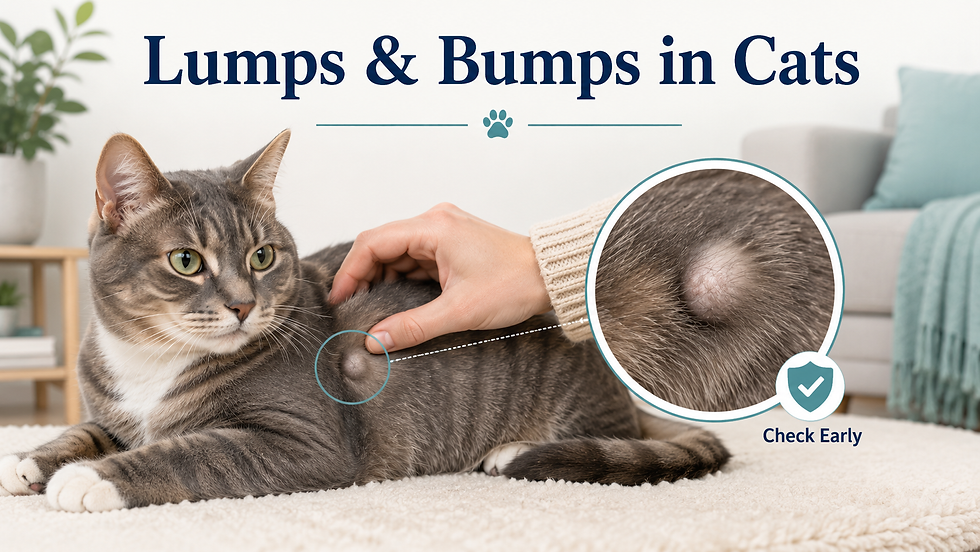
Discovering a new lump on a dog or cat can be alarming. Some masses are harmless fatty growths, cysts or warts, while others may be inflammatory lesions or tumours that require treatment.
Unfortunately, it is not usually possible to determine whether a lump is benign or malignant by appearance or touch alone. A soft, slow-growing mass may still need testing, while a firm or rapidly changing lump does not automatically mean cancer.
At Lonsdale Place Veterinary Clinic, we recommend documenting new masses and having them assessed rather than relying on guesswork.
North Vancouver Vet
What Counts as a Lump or Mass?
A mass is any abnormal swelling, thickening or growth found on or beneath the skin.
It may feel:
Soft or firm
Smooth or irregular
Fixed in place or movable
Painful or painless
Fluid-filled or solid
Superficial or deep beneath the skin
Some masses remain unchanged for years. Others enlarge, become inflamed or change very quickly.
Lumps may occur anywhere, including:
The chest or abdomen
The legs and paws
The head or neck
Beneath the tail
Around the mouth
Along the mammary glands
Beneath the skin
Inside the ear
Between the toes
North Vancouver Vet
Are All Lumps Cancerous?
No. Many skin and subcutaneous masses are benign. Common non-cancerous possibilities include fatty masses, cysts, warts, blocked glands and areas of inflammation.
However, cancerous masses can resemble benign growths. Some mast cell tumours, for example, may look like a wart, insect bite or allergic swelling and can fluctuate in size.
This is why appearance alone is unreliable.
The safest principle is simple: a lump should be sampled rather than watched indefinitely when its identity is unknown.
North Vancouver Vet
Common Types of Lumps
Lipomas
Lipomas are benign fatty masses commonly found beneath the skin of middle-aged and older dogs.
They are often:
Soft
Movable
Slow-growing
Painless
Even when a mass feels typical of a lipoma, sampling is generally recommended to confirm that it contains fat cells. Other tumours can occur in the same locations and may feel similar.
Some benign fatty masses become large enough to interfere with walking, lying down or normal limb movement. In those cases, removal may be discussed despite the mass being non-cancerous.
Cysts
Cysts are sacs that may contain fluid, keratin or other material.
They may appear as:
Smooth, rounded bumps
Firm nodules
Growths with a visible pore
Lumps that periodically rupture or drain
Do not squeeze a suspected cyst. Rupturing it may cause pain, inflammation or infection, and the lump may refill if its lining remains.
Warts and Papillomas
Papillomas are wart-like growths that are particularly common in dogs. Some are associated with viruses and may resolve as the immune system responds, especially in younger dogs. Others persist or become irritated.
A wart-like appearance does not guarantee that a mass is benign. Other tumours can have a similar surface.
Abscesses
An abscess is a pocket of infection beneath the skin. It may develop after a bite wound, puncture or foreign object.
Possible signs include:
Sudden swelling
Heat
Pain
Redness
Pus or discharge
Fever
Reduced appetite
Low energy
Abscesses can enlarge quickly and may rupture. They require veterinary assessment and often need drainage, cleaning, pain relief and sometimes antibiotics.
Insect Bites and Allergic Swellings
Bites or stings may cause a temporary raised area. Allergic reactions can also produce multiple small bumps called hives.
Seek urgent care if swelling is accompanied by:
Facial swelling
Vomiting
Weakness
Collapse
Difficulty breathing
Pale gums
Rapidly worsening symptoms
Malignant Tumours
Cancerous masses vary widely. They may be soft or hard, fast- or slow-growing, painful or painless.
Features that increase concern include:
Rapid growth
Ulceration
Bleeding
Irregular shape
Firm attachment to deeper tissue
Recurring after removal
Changing size
New pain
Nearby lymph-node enlargement
However, the absence of these features does not confirm that a mass is harmless.
North Vancouver Vet
What Is a Fine-Needle Aspiration?
A fine-needle aspiration, or FNA, is a commonly used test for lumps and bumps.
A small needle is inserted into the mass to collect cells. The cells are placed on microscope slides and evaluated either within the clinic or by a veterinary pathologist.
FNA is widely used to sample external masses and can also be used for lymph nodes, internal organs and abnormal fluid collections.
Many pets tolerate the procedure while awake because the needle is similar in size to one used for an injection. Sedation may be recommended when:
The mass is painful
The pet is very anxious
The location is sensitive
The pet cannot remain still safely
Ultrasound guidance is required
North Vancouver Vet
What Can an FNA Tell Us?
Cytology may identify:
Fat cells consistent with a lipoma
Inflammatory cells
Bacteria or infection
Cyst contents
Mast cells
Lymphoma
Other tumour-cell populations
Sometimes the sample is not diagnostic because the mass does not release enough cells or because tissue architecture is needed to identify it accurately.
When cytology is inconclusive, a biopsy may be recommended.
North Vancouver Vet
What Is a Biopsy?
A biopsy collects a piece—or sometimes all—of the mass for histopathology.
A pathologist evaluates how the cells are arranged within the tissue. This can provide information that a needle sample cannot, including:
The precise tumour type
Whether it is benign or malignant
How aggressive it appears
Whether a removed mass has clean surgical margins
Whether additional surgery or treatment may be needed
Lumps are often impossible to diagnose by appearance alone, while microscopic evaluation of cells or tissue can provide a classification and diagnosis.
North Vancouver Vet
Why Sample Before Removing a Mass?
Owners sometimes ask why a veterinarian would sample a lump if it is going to be removed anyway.
Knowing the likely type of mass before surgery can help the veterinarian plan:
How wide the surgical margins should be
Whether imaging is needed first
Whether nearby lymph nodes should be sampled
Whether referral is appropriate
Whether removal is urgent
Whether another treatment should be performed first
A benign mass may be removed with relatively narrow margins. Certain malignant tumours require a wider removal that includes apparently normal surrounding tissue.
AAHA senior-care guidance recommends fine-needle aspiration of masses before surgery so appropriate margins can be planned.
North Vancouver Vet
Should Every Lump Be Removed?
Not necessarily.
The decision depends on:
The diagnosis
Size and location
Rate of growth
Whether it causes pain
Whether it interferes with movement
The pet’s age and overall health
The likelihood of malignancy
Whether the mass is ulcerated or infected
Surgical and anesthetic considerations
A confirmed benign mass that remains small and causes no discomfort may sometimes be monitored. A mass on a paw, eyelid or joint may require removal sooner because even a small amount of growth can interfere with function.
Monitoring should be an active plan, not simply forgetting that the lump exists.
North Vancouver Vet
How to Monitor a Lump at Home
Create a record containing:
The date it was first noticed
Its exact location
Approximate length and width
A clear photograph
Whether it is soft or firm
Whether it moves beneath the skin
Any redness, bleeding or discomfort
Place a ruler or coin beside the mass when photographing it to show scale.
Recheck it regularly and note any changes. A body map can be particularly useful for pets with multiple masses.
Do not repeatedly squeeze or manipulate the lump. This may irritate certain types of masses and make changes more difficult to interpret.
North Vancouver Vet
Changes That Require Prompt Assessment
Arrange an appointment when a lump:
Is newly discovered
Is increasing in size
Changes colour or texture
Becomes red or swollen
Bleeds or develops an open surface
Produces discharge
Becomes painful
Suddenly changes size
Interferes with walking, eating or toileting
Returns after previous removal
Is located inside the mouth
Is associated with weight loss or reduced appetite
Any mass can be evaluated, regardless of how long it has been present. Owners should not avoid mentioning an older lump because they are worried it has been there “too long.”
Special Considerations for Cats
Cats can develop benign and malignant masses just as dogs can. Any persistent lump in a cat should be assessed.
For a mass arising near a previous injection or vaccination site, veterinary guidelines use the 3-2-1 rule as a reason to pursue biopsy:
The mass remains present for three months.
It is larger than two centimetres.
It is increasing in size one month after the injection.
A mass meeting any of these criteria warrants further investigation.
This does not mean every post-injection swelling is cancerous. Small, temporary swellings can occur, but persistent or enlarging masses should not be ignored.
North Vancouver Vet
Do Not Wait for a Lump to Become Painful
Many tumours do not hurt during their early stages. A pet may continue eating, playing and behaving normally despite having a significant mass.
Waiting for pain or illness before arranging an examination can allow a tumour to become larger and more difficult to remove.
Earlier assessment may provide:
More treatment options
A smaller surgical procedure
Better surgical margins
Faster relief from discomfort
More useful information for planning
North Vancouver Vet
What to Expect at the Appointment
The veterinary team may:
Examine and measure the mass.
Check the rest of the body for additional lumps.
Examine nearby lymph nodes.
Perform a fine-needle aspiration.
Recommend cytology or histopathology.
Discuss bloodwork or diagnostic imaging.
Develop a monitoring or treatment plan.
Depending on the suspected diagnosis, chest X-rays, abdominal ultrasound or lymph-node sampling may be recommended before surgery.
North Vancouver Vet
Have New Lumps Checked Early
Most newly discovered lumps are not emergencies, but they should not be diagnosed by appearance or touch alone.
Contact Lonsdale Place Veterinary Clinic when you find a new mass or notice a change in an existing one. Sampling is often quick and minimally invasive, and the information gained can help distinguish a harmless growth from one requiring timely treatment.
Finding a lump can be worrying, but early evaluation replaces uncertainty with a clear and informed plan.


